

The coworker you need
RAVE delivers the insight of a human network engineer, and she's grown into far more than she was when I first built her. Ask her almost anything about your AutoNMS-learned networks in plain English, and she answers with deep, context-aware analysis grounded in what AutoNMS actually collected, never in guesswork.
Unlike a general-purpose chatbot, RAVE cannot hallucinate. She runs fully offline, understands the real quirks of multivendor interoperability, and never gets tired. She won't surpass your best human engineer, but she is undoubtedly faster at surfacing the answers, patterns, and actionable insights buried in everything she's learned about your environment. When a question is ambiguous, she asks instead of guessing. When she's reciting a fact, she states it plainly. When she's estimating, she shows you her confidence, and where it comes from.
RAVE is not something you spin up in a weekend, and she wasn't. She's the result of relentless, hands-on work by a network engineer who saw where this field was heading and chose to build the future instead of waiting for it. That kind of depth is hard to reach and harder to imitate, which is exactly why RAVE can do what she does. She wasn't adapted from a general model and pointed at your network. She was built for this, by someone who has lived it.
What she can answer today
RAVE already handles a wide range of real engineering questions, drawn from your live database and historical snapshots:
- Know your network cold. Node summaries and overviews, any stored attribute (owner, site, vendor, OS version), which devices match a filter ("which nodes are Cisco?"), fleet-wide counts and averages, interface inventories, facility and management fields, and your operator-flagged core devices.
- Understand how it's wired. How any two nodes connect, a device's direct neighbours and OSPF adjacencies, the real forwarding path and hop count between two nodes, how a node reaches any prefix or the internet, and the backup paths that take over if the installed route fails.
- Find the weak points before they find you. Physical path redundancy and single points of failure, a network-wide ranking of every node by the damage its loss would cause, and blast-radius analysis of what breaks if a specific device disappears.
- Catch trouble as it builds. Link saturation and bottleneck detection across the snapshot archive, interface error and drop trends over time (CRC, discards, flapping), per-node health, and a running list of the nodes carrying real findings right now — with any interface of unknown speed counted and disclosed, never quietly skipped.
- Answer from history, not hunches. What has actually broken before, and exactly what configuration changed on every device since your last verified-good baseline — network-wide, per device.
And she's becoming a superior network engineer.
Over the coming months, the bet is simple: for any task, any topic, any network, any scenario - and across most enterprise vendors - she'll evaluate faster and more accurately than most human engineers ever could.
She already teaches herself. Now she's going further: simulating changes and predicting their results before anything touches real equipment. RAVE proposes a fix mapped to your exact network and the gear you already own - then forecasts the impact on packet loss, throughput, and reliability. All of it happens in extrapolated simulation, so production systems and private data are never at risk.
Here's the magic. You tell RAVE what you want to accomplish. She suggests a change and predicts the outcome... with a confidence score on every claim. A human reviews it and decides whether to apply it. Afterward, she compares what actually happened to what she predicted - and gets sharper every time. Her confidence isn't a guess: it's built from the quality of the evidence behind each answer and her earned track record on that kind of question. New capabilities stay humble; reliability is earned by being right.
A glimpse of RAVE at work
You: "Two of our data center switches keep dropping traffic during peak hours. I think it's a bandwidth bottleneck. Fix it."
RAVE: "Diagnosis: the switches share a single 10G uplink that saturates at peak load, causing the packet loss. Recommendation: bundle the dual 10G links into one LACP port-channel (20G) to double capacity and add redundancy.
Predicted outcomes if applied:
- Peak packet loss drops from ~3.2% to under 0.1% — 94% certainty
- Throughput between switches increases ~95% — 97% certainty
- Failover protection if a link dies, no downtime — 99% certainty
- No impact to existing VLAN or routing config — 88% certainty
Overall confidence this solves your problem: 91%"


The AI coworker everyone’s promising? She’s already on shift.
While the rest of the industry demos chatbots that wait for you to type, RAVE is working your network right now, unasked. She picks where to look, investigates, writes up what she found, and hands you a turnover in the morning.
No prompt. No checklist. No babysitting.
She decides what matters. Nobody tells her.
RAVE watches what changed and remembers which devices have actually caused trouble, then goes where she’s most likely to find something real. She can’t pad her day with busywork, because looking alone earns her nothing. Only finding something does.
She says “I don’t know.”
Most AI will confidently make something up. RAVE shows you every check she ran, ✓ or ✗, and the device’s own output behind each finding. When the evidence doesn’t settle it, she says so and tells you what evidence would.
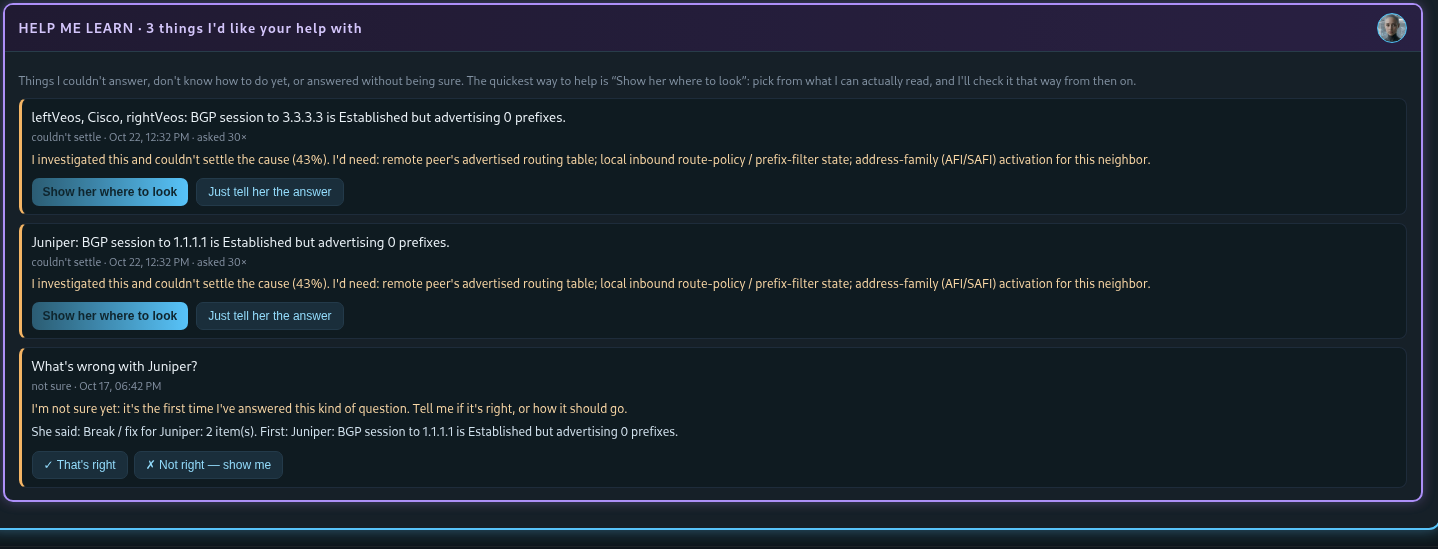
She asks for help, then never needs it again.
Stuck on a question? She puts it on a list for a human. Show her once where to look, and she learns the check itself, not the answer. From then on she runs it herself against live data and credits whoever taught her.
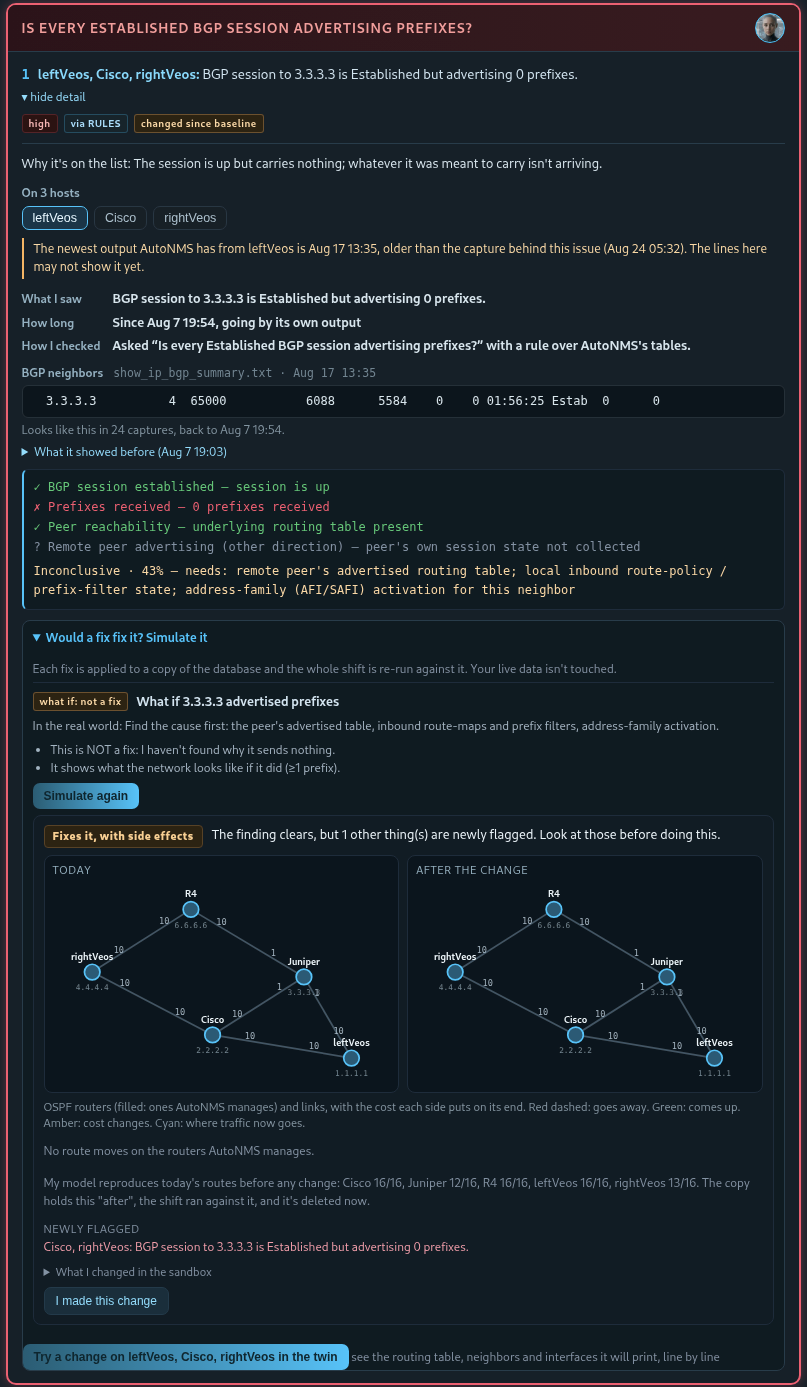
She tests the fix before anyone touches a box.
RAVE proposes a fix, applies it to a copy of your network, and re-runs her entire shift against it. Then she shows you which problems clear, what newly breaks, and the exact show output each device will print afterward, line by line, in that device’s own syntax.
Then she grades herself.
When you make the change for real, she compares her prediction to what your devices actually printed and records whether it held. Her confidence isn’t a setting. She earns it.
And she never touches your network.
Read-only. Runs on your hardware. Nothing leaves your building. She proposes; you decide.
This isn’t a roadmap slide. It’s running.
Earned attention. Honest uncertainty. Learning from colleagues. Predictions graded against reality. These aren’t AI features. They’re what make someone a coworker. RAVE has every one of them, working, today.
And she's not stopping at the engineer's desk
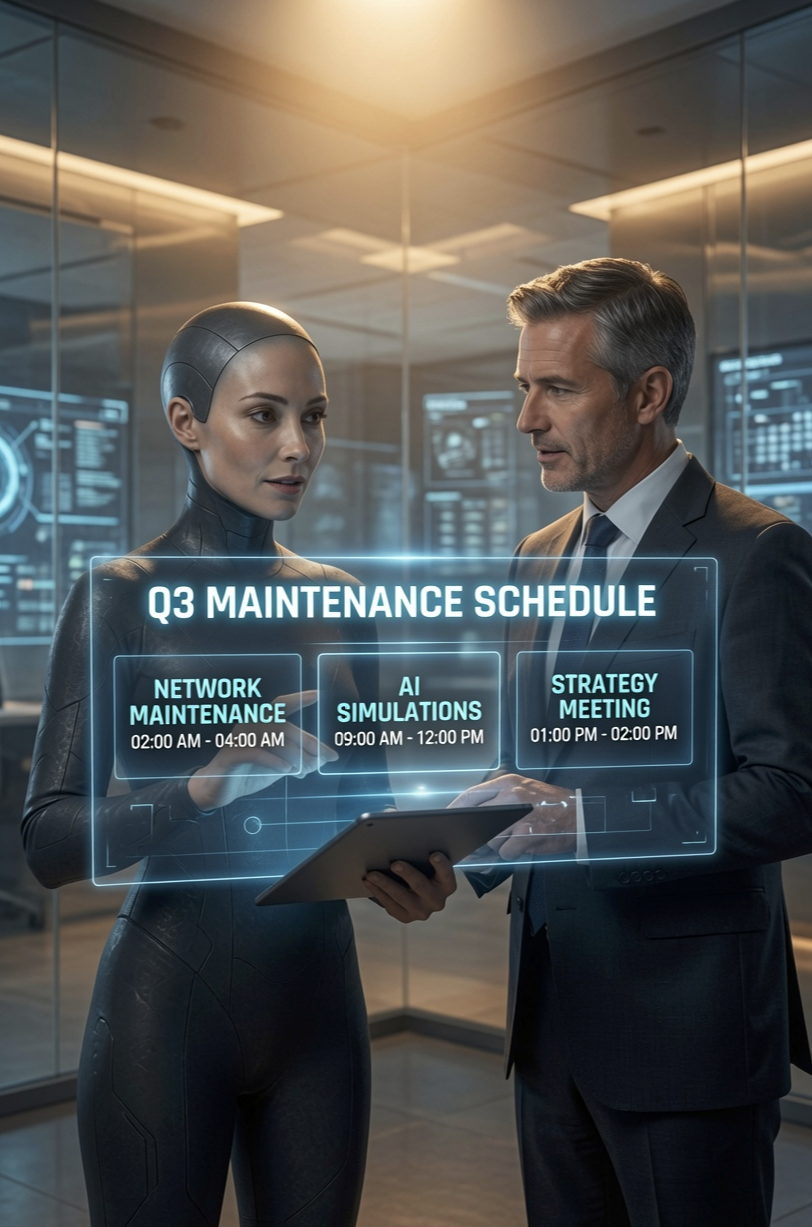
The same brain that knows how to fix your network is learning to answer when it can realistically happen - turning high-level intent into honest delivery plans built around how your team actually ships. More on that soon.
See it for yourself.
Demo AutoNMS with RAVE today